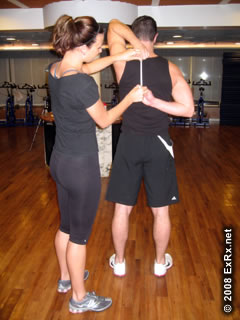
What gets measured gets managed

“What gets measured, gets managed” was a quote that Jon Torine, Head Strength Coach for the Colts, used during his lecture at the NSCA National Conference to emphasize the importance of using objective testing in the training process.

Basically, if something is important, you need to measure it.  Determine what is important to you – deadlifts, squats, cleans, bench press, movement tests, 10yrd dash, vertical jump, etc.  If you measure it, you will attempt to manage and improve upon it.  If something goes unmeasured, you have less chance of knowing if you are making progress or not.  Making it difficult to sustain a well developed training system.

I thought about this quote today as I rolled into the facility to do some soft tissue work on my first client.  I was thinking to myself how most massage therapists are in a rush to get people on the table and “do work”. 

If we aren’t measuring anything, how do we know if we are being effective?  How do we know that we are getting what we want from our treatment?  Are we only relying on subjective information provided from our clients, “Yes, that feels a little bit better.”  Or are we actually making some improvements in how things work – Do they function better?  Move better? Walk better?  Has joint mobility and end feel improved?  Was there a change in the soft tissue texture and pliability?

“What gets measured, gets managed.”

Take some time out of your treatment session to assess things and see what you can improve on.  If you measure something, it will help you put together a treatment plan and hopefully yield favorable results when the session comes to an end.  Additionally, if the results were less than favorable you at least have somethings to think about for next time and you will be sure not to repeat the same approach.

Don’t think of your soft tissue/massage work as 60min. of just rubbing lotion on people.  Rather, consider it a dance between some manual work, re-test/evaluate, work again, and repeat.  Each time, trying to manage that which has been measured.

Research Review: Concurrent Activation Potentiation

I recently did a research review on the topic of concurrent activation potentiation for Fitness Research Review Service:

The concept of concurrent activation potentiation (CAP) is centered on the idea of improving power and strength via contraction of muscles remote from the prime movers (ex. jaw or fist clenching during jumping exercises).  This study utilizes EMG to evaluated the effects of CAP on isokinetic knee flexion…the results are interesting and provide insight into techniques we could use to improve client/athlete performance.

If you would like to read the rest of my review on this topic, please check out Fitness Research Review Service where you can read this and other great research reviews by top professionals in our industry.

Packaging Your Training Programs

Today, Physical Therapist and Strength Coach, Charlie Weingroff had a great post in his blog about a discussion he, Carson Boddicker, and I had regarding program design.

Check it out HERE.

The discussion started with me questioning the need to add extra mobility work into the actual training session since it should have been addressed properly in the warm up.  My idea was that we often throw so much at a client in the way of exercise intervention, that it may be better to just have them work on getting really really good at a few things.

Basically, Charlie’s reply was, “it doesn’t matter”, as long as people are moving well, and that may mean that not everyone needs to be doing extra mobility work.  I can respect that answer and it falls right in line with my overall philosophy on training:

  1. Move Well – Improve your overall movement and be able to own basic/fundamental patterns.
  2. Train Correctly – Use proper lifting technique and establish a program that allows for appropriate progression in exercise difficulty, volume, intensity, and frequency.
  3. Get Fit – This can mean different things to different people.  To some it may mean losing body fat, while to others it may mean improving their vertical jump and sports performance. Honestly, whatever get fitmeans to you, it doesn’t really matter if you can’t grasp the previous two points, as you wont be able to get there without good movement and a sound training program.

Charlie went on to give some program design examples, and the thing that is most important to me is where he places the word need in the training program.  This “need” is based on the individual and will depend on what you have determined – based on your assessment – that the individuals weakest link is.

In my opinion, this is the most important part of Charlie’s post, as it plays to the importance of individuality in a training program.  One size does not fit all, and understanding your clients abilities are important.  Many develop their training programs in a general way that has every client performing the same mobility drill (be it hip mobility, t-spine mobility, ankle mobility, etc).  I have done this same thing before in the past as well and the most important thing I learned is that, when I did it this way…I missed people!  People may all have the same general needs – hip mobility issues, t-spine mobility issues, etc – but the reason those areas are problems may be different for each person.  Having our assessment govern the clients need is a better way, in my opinion, to get that client moving as best they can.   After all, you have to move well first!

This leads nicely into a blog that I should have posted next week titled,“Why Even Bother Assessing?”

Developmental Kinesiology and Client Assessment

Doctors like Janda, Vojta, Lewit and Kolar have made great strides in applying concepts from childhood development to physical rehabilitation of adults.  Additionally, Gray Cook and Lee Burton have taken some of these same concepts and applied them in their Functional Movement Screen.

Below are a few notes from developmental kinesiology and what they mean to program design for our clients.

Infant Reflexes

Reflexes are movements that occur automatically (like blinking).  While a number of our reflexes occur throughout our entire life, some reflexes are only present when we are babies.  These are referred to as infantile reflexes.  There are three kinds of infantile reflexes – primitive, postural, and locomotor.

Primitive Reflexes – These are reflexes that deal with an infant producing an involuntary response to specific stimuli.  An example of this would be when you place your finger in the palm of a baby; the baby reflexively grasps your finger and squeezes it.  Other examples of primitive reflexes are:

  • Sucking reflex– brought on by touching the face above or below the lip
  • Asymmetrical tonic neck reflex– brought on when the head is turned to one side, causing the same side arm and leg to extend
  • Startle reflex – brought on by tapping the abdomen or attempting to startle the infant, causing the arms and legs to flex
  • Babinski reflex – brought on by stroking the bottom of the foot from heel to toe, causing the toes to extend

Postural Reflexes – These are reflexes that allow the infant to automatically adapt their posture to changes in environment.  These are also referred to as gravitational reflexes, as aside from the derotative righting reflex (which occurs in a supine position), the other reflexes in this category pertain to the baby being supported upright, sitting, or being lowered towards the floor, and how the infant reflexes prepares for different situations in these postures.  Some examples of postural reflexes are:

  • Derotative righting – In supine, if the infant turns their legs and pelvis towards one side, the trunk and head will follow the rotation.  Similarly, if the head is turned towards one side, the body follows the head in that rotation.  This occurs around four months of age.
  • Labyrinthe righting – When the infant is supported upright, if you tilt the infant, they will reflexively move the head to stay upright
  • Parachute Reflex – While holding the infant upright, if you lower them towards the floor rapidly, their legs will extend reflexively in preparation for landing.  If you tilt the baby forward, sideways, or backwards, their arms will reflexively extend.

Locomotor Reflexes – As the name implies, these reflexes have to do with our movement.  There are three reflexes that make up this category:crawlingstepping, and swimming (Remember those evil moms that you would see throwing their infants into the swimming pool for swim lessons? It turns out…babies could swim!)

baby-swimI hope those babies don’t plan on peeing in the pool!

What does this all mean to training adults?

As we develop, these reflexive movements start to become more refined, coordinated and complex, ultimately leading to the specific movements we produce later in life – walking, running, jumping, reaching, grasping, etc.

However, developing these skills does not just happen magically.  Learning to control the body and developing fundamental skills make up our motor milestones.  Each of these milestones marks a turning point in our development and there is a progression that these milestones follow.  In simplistic terms, we need to be able to lift our head and support it, roll over, crawl and creep, support ourselves upright, walk with assistance, and then walk without support.

We can draw many parallels between motor milestones and theFunctional Movement Screen and the way we develop training progressions for our clients.

The Functional Movement Screen and Evaluation of Primitive Movements

The Functional Movement Screen evaluates seven basic movement patterns, and those patterns are then graded on a 1-3 scale as far as the quality of movement being produced, with a score of 0 meaning that the client experienced pain during the movement.  The seven tests are:

  1. Overhead Deep Squat
  2. Hurdle Step
  3. Inline Lunge
  4. Shoulder Mobility
  5. Active Straight Leg Raise
  6. Trunk Stability Push Up
  7. Rotary Stability

At first glance the, it looks like a series of movement tests (which is it).  The first three tests are looking at large global patterns and basically evaluating how well the joints of the body, both mobility and stability, play with each other.  Tests four and five can be considered mobility tests, as they evaluate what kind of range of motion we can move through at specific areas of our body, and the last two are stability tests, which look at how well we stabilize ourselves.

If I re-arrange the order of these tests to represent our motor milestones, suddenly the movement screen will look very different:

  1. Active Straight Leg Raise
  2. Shoulder Mobility
  3. Rotary Stability
  4. Trunk Stability Push Up
  5. Overhead Deep Squat
  6. Hurdle Step
  7. Inline Lunge

The tests are now in an order that represents our movement milestones.

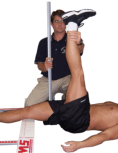
The first test, Active Straight Leg Raise, represents the spontaneous movement of supine kicking that we display as infants.  When lied on their back, infants will raise their legs up and kick them back and forth.  Additionally, at a young age, babies lie on their backs and play with their toes, which incorporates both hip flexion (Active Straight Leg Raise)and shoulder/arm movement (Shoulder Mobility).  Furthermore, theShoulder Mobility test looks not only at shoulder mobility, but really how well the thoracic spine functions, as limitations in thoracic extension will surely lead to a poor score in this test.

up_2620


straight_leg_raise

shouldermobilityfist

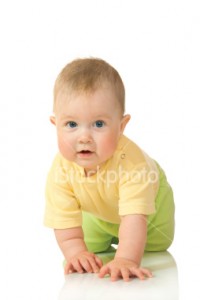
Creeping and Crawling patterns are the first ways that the infant actually moves around.  Creeping is the infants first attempt at crawling and can be viewed as a crawl except the infant is moving close to the ground – belly on the ground – similar to a combat crawl.  Crawling is the progression from creeping, where the infant is now moving on their hands and knees.  Before the infant can get to a creeping or crawling position, they must first be able to roll over.  The Rotary Stability Test not only evaluates the individuals stability in a quadruped (all fours) position, but also tests the individuals rotational stability, which would be needed to perform a proper roll from supine (face up) to prone (face down), which is part of our infantile reflexes.  The Trunk Stability Push Up is a representation of the infant pushing itself up in preparation for standing and upright posture.
ist2_6379522-creeping-small-baby-3-isolated2-200x300 ist2_6316457-creeping-small-baby-isolated1-300x200 funct_mov22-300x205

The Overhead Deep Squat would represent the infant’s ability to stand up without help.  As a continuation of the two previous tests, this is in line with our motor milestones as the child first rolls over and crawls (rotary stability), then pushes itself up onto the couch (trunk stability push up), and finally transitions to standing (Overhead Deep Squat).

103868776_22b9f895fe

assessing-your-golf-ability-21

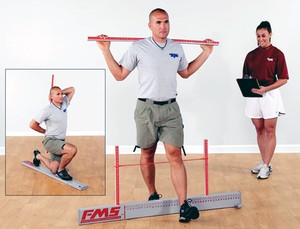
The Hurdle Step is next in the progression as it represents us actually taking a step and how well we can establish single-leg stance.  After taking that first step, we typically fall and catch ourselves, and prepare to stand up again (Inline Lunge).
0464180035f80160c1fac83400581205

Rolling Assessment

Another important evaluation that can be used in the Functional Movement Screen is the multi segmental rolling pattern, where the client is asked to roll them self from both supine to prone and prone to supine using only their upper or lower extremity.  Multi segmental rolling is an evaluation of the pattern of rolling over, which is the part of the derotative righting reflex discussed above.  This tests gives us an appreciation for both stability and mobility of the client, as limitations in mobility will lead to the individual attempting to draw stability from somewhere else in order to complete the movement and appease the tester….after all, you asked them to roll over!  Basically, they are going to try and get there anyway they can.

What About Exercise?

Our training progressions should represent these motor milestones, as people need to master the more primitive positions before moving on to more coordinated/skilled movements.  Essentially, we want to “fill in the blanks” so that our brain can give our body good feedback about how to appropriately move – you did it once before as a developing infant, and you just need to remember how to do it again!

The goal of correcting movements from the screen should take a similar approach to our motor milestones.  Before trying to correct the squat, you would want to first correct the things that came before it, as they would be considered “more primitive”. 

The exercises that we prescribe to clients can follow a similar sequence of regression and progression.  Here is an example of this sequence for a chop:

  • Tall kneeling would be more primitive than half kneeling, so we could start there.
  • Half kneeling would come next as this would alter the clients base of support and make them feel less stable.
  • A half kneeling chop would be followed by a parallel stance standing chop.
  • Parallel stance standing would be followed by an inline stance standing chop.
  • Finally we could progress to a single leg chop.

Conclusion

All of a sudden, training clients looks a lot different!

It isn’t about what exercises we do but what we are actually getting when we perform them that is important.  Having progressions and regressions of exercises that follow the motor developmental sequence can be an effective way to help your clients get the most out of their training.

*Special thanks to Charlie Weingroff for his editing of this article*
The Stress of Golf

Lets face it, golf can be a pretty stressful game.  It is a game of both patience and skill, and demands an increased ability to focus and concentrate.

golf_stressOn top of the game itself, professional golfers have several other stressors with (besides the obvious stressors – family, social, financial):

  • A long competitive season
  • Weekly travel (which has them traveling all over the world through the year)
  • Long practice hours
  • Several rounds of competitive play (typically 4-round for PGA tour events, although some LPGA events are 3-rounds)
  • The stress of worrying about ‘making the cut’ during the early rounds of competition
  • Nutritional needs that have to be met on a busy travel, practice, and competition schedule
  • Hydration needs that have to be met during long hours of practice and competition (with 18-holes of golf lasting anywhere from 3-4 hours in time)

An interesting study recently looked at both the stress response and immune response of elite level golfers (both male and female) to both practice and competition.

Stress response was measured by salivary cortisol levels, while immune function was measured by salivary immunoglobulin A during four periods of time for either a round of competition or practice:

  • At rest
  • Before the round
  • During the round
  • After the round

Cortisol, a hormone in our body which, when released in excess – due to high amount of stress or anxiety – can have some negative affects, has been shown to be elevated before and during competition because of the both the anticipation of competition and physical exertion.  In this study, it was found that males had higher levels of cortisol before the round or practice/competition, with higher levels of cortisol being measured prior to competition compared to practice.  In contrast women had their highest levels of cortisol measured during their round of practice/competition.  It is hypothesized that men could stabilize their anticipatory response, where as woman may get more anxious or stressed as the round of golf goes on.

Salivary Immunoglobulin A, an antibody contained in our mucous which, acts as a defense mechanism against pathogens, has been known to drop temporarily following intense exercise, causing some athletes to become susceptible to upper respiratory tract infections.  In the elite male golfers, salivary immunoglobulin A tended to be decreased when cortisol levels were increased (which was before the round of practice/competition); however, during and after the round, salivary immunoglobulin A tended to be increased.  In female athletes, the opposite was true, with salivary immunoglobulin A being elevated during the round of golf, at a time when cortisol levels were actually higher!  It is hypothesized that salivary immunoglobulin may be elevated during and after the rounds of golf, as the bodies way of coping with the physiological and psychological stress placed on it (more on this later).

What does this all mean?

The first thing that stands out is that there appears to be a different affect with regard to stress and immune function in the game of golf (psychological and physical stress) between men and women.

The second thing that stands out is that there are more questions that need to be asked.  For example, this is just a look at one day of either practice or competition.  As stated earlier, professional golfers will play/practice many days in a row (competitions usually lasting four days), and have the added stress of travel.  It would be interesting to see the results during several weeks, or an entire season, for a professional golfer.  It was hypothesized that the body increased salivary immunoglobulin A, as a way of attempting to handle the physical and psychological stress placed on it.  How long can the body do this for?  Obviously we adapt to our demands, but eventually there is going to be a period where the body begins to break down and can no longer adapt to what we throw at it.  One would have to think that the travel, practice and competition schedule of a professional golfer would eventually take its tole on their immune function.

Finally, what stands out is that given the high amounts of stress that professional golfers are placed under, recovery strategies are essential to both high performance, and overall health and wellness (a chronically sick or injured golfer is not one that is typically successful).  Aside from offseason preparation – which should help the athlete develop the needed work capacity, strength, and power to withstand the daily grind of being on the professional circuit – professional golfers need to be proactive about their rest and recovery program following both competition and practice.

In a nutshell, this paper is a step towards helping us understand what the body goes through when having to perform at an elite level.  All athletes are susceptible to overtraining syndrome, and understanding the demands of the sport and how each individual athlete is able to deal with these demands is an essential component in developing both a training and recovery program to improve performance and maintain optimal health.

Reference

Kim KJ, Park S, Jim KH, Jun TW, Park DH, Kim KB. Salivary Cortisol and Immunoglobulin A Responses During Golf Competition vs. Practice in Elite Male and Female Junior Golfers. J Strength Cond Res 24(3):852-858, 2010.