Author Archives: Patrick

Using Beta-Binomial Regression to Set Priors for Different Sample Sizes

In a prior post I explained an approach for using Bayes to estimate a player’s 3pt% based on prior knowledge of 3pt success in NBA players. This approach took advantage of the beta-binomial conjugate.

In that post, I constrained our analysis to only players that had 200 or more 3pt attempts during the course of a season. But, what if we don’t want to only focus on players that obtained a certain number of 3 point attempts? What about players who only took 100 attempts? 10 attempts? 2 attempts?! What can be said about their performance?

Today, we will discuss the approach of using beta-binomial regression to first establish a prior 3pt%, based on the number of 3pt attempts the player shot (sample size) and then update that prior based on the success that the player had in those attempts.

The code for this article is available on my GITHUB page.
A few references of books that I’ve found useful for building Bayesian models are at the end of this post. The approach here was inspired by Chapter 7 of David Robinson’s fantastic book, Introduction to Empirical Bayes: Examples from Baseball Statistics.

The Data

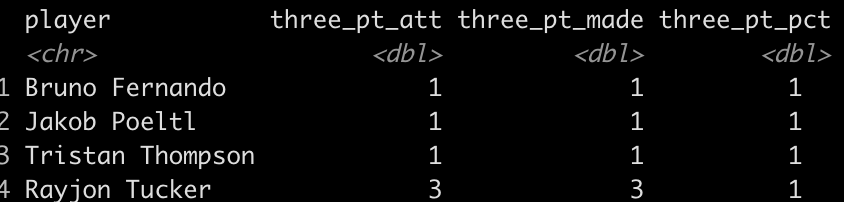
We will use the three point attempts data for all players in the 2022 NBA season. Data was scraped from basketball-reference.com. In total, there are 740 rows of data. Here is what the first four look like:

Plotting the Data

To help wrap our heads around the relationship between 3pt% and 3pt attempts, we will build a simple plot.

Notice that the number of 3 point attempts has some influence on 3pt%. First, as 3pt attempts increase, so does 3pt%. This is because better 3pt shooters will take more 3pt shots and, because they are good, their teams will also try and put them in position to take these shots.  Additionally, we can see that as 3pt attempts increase, the amount of variance in performance decreases. Players with under 100 3pt attempts are relatively spread out around the regression line.

Bayesian Shrinkage using the Beta-Binomial Conjugate

As a review from the prior blog article on this topic, we can use our knowledge of the 3pt% success of NBA players as a prior to help shrink observations towards the “expected” outcome. The amount of shrinkage a player exhibits will be dependent on the number of 3pt attempts they have. A smaller sample size means we have less confidence in the observed performance and thus greater shrinkage towards the population prior. Conversely, a large sample size means more confidence in the observed performance and therefore much less shrinkage.

From the prior article we estimated the alpha and beta parameters for our beta distribution to be 61.8 and 106.2, respectively. Recall that these values were estimated from the prior 2 seasons and using only those players with 200 or more 3pt attempts. The alpha and beta parameters provide us with a prior mean for NBA 3pt% of 36.8%.

We will apply this prior knowledge to the observations of all players in our 2022 data set by using the beta-binomial conjugate.

alpha <- 61.8
beta <- 106.2

prior_mu <- alpha / (alpha + beta)
prior_mu

tbl2022 <- tbl2022 %>%
  mutate(three_pt_missed = three_pt_att - three_pt_made,
         posterior_alpha = three_pt_made + alpha,
         posterior_beta = three_pt_missed + beta,
         posterior_three_pt_pct = posterior_alpha / (posterior_alpha + posterior_beta),
         posterior_three_pt_sd = sqrt((posterior_alpha * posterior_beta) / ((posterior_alpha + posterior_beta)^2 * (posterior_alpha + posterior_beta + 1))))


Next, we create a plot to see how the beta-binomial posterior for each player looks relative to the raw data (plotted on the left):


Combining our prior and observed values we can see (on the right) that the data are now constrained around the prior (36.8%). Players with a small number of observations (on the left) are pulled nearest to the line while players with larger observations (on the right) are less influenced by the prior and tend to remain closer to their observed performance.

The problem is that the prior mean (36.8%) is too high for the players with a small number of 3pt attempts. Surely we wouldn’t want to make the assumption that their performance is close to the prior for players that had over 200 attempts! For example, the players with under 50 attempts have an observed average 3pt% of 30% and a median 3pt% of 25% (just over 10% less than those those who had 200 or more attempts!).

To deal with this issue we need to account for shot attempts first so that we can estimate players with smaller sample sizes relative to a prior performance that is more appropriate for them (IE, a prior that is lower than that currently being assumed by our alpha and beta parameters).

Accounting for 3pt Shot Attempts

Our outcome variable is binomial (success and failures) so we will use a beta-binomial regression to estimate a prior for 3pt% while controlling for 3pt shot attempts.

suppressPackageStartupMessages({
  suppressWarnings({
    library(gamlss)
  })
})

fit_3pt <- gamlss(cbind(three_pt_made, three_pt_missed) ~ log(three_pt_att),
                  data = tbl2022,
                  family = BB(mu.link = "identity"))

## extract model coefficients
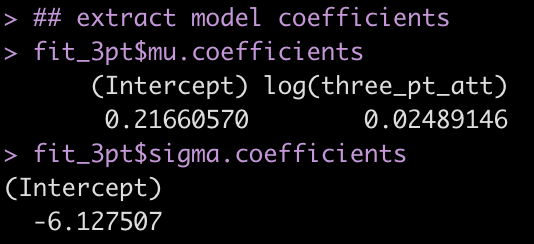
fit_3pt$mu.coefficients
fit_3pt$sigma.coefficients


Now we can use these model coefficients to fit an estimated 3pt% for each player based on their number of 3pt attempts. This estimation will serve as our prior, which we will then turn into a new posterior 3pt% for each player using our beta-binomial approach. Note that while the mean 3pt% for each player will vary depending on shot attempts the population sigma will be constant for all athletes, representing the variance that we expect all of those in the population to similarly exhibit.

tbl2022 <- tbl2022 %>%
  mutate(mu = fitted(fit_3pt, parameter = "mu"),
         sigma = fitted(fit_3pt, parameter = "sigma"),
         prior_alpha_reg = mu / sigma,
         prior_beta_reg = (1 - mu) / sigma,
         posterior_alpha_reg = prior_alpha_reg + three_pt_made,
         posterior_beta_reg = prior_beta_reg + three_pt_missed,
         posterior_mu_reg = posterior_alpha_reg / (posterior_alpha_reg + posterior_beta_reg))


We now have two estimates of each player’s 3pt%. One that was calculated using the beta-binomial conjugate with a prior of 36.8% (the average 3pt% for all shooters with 200 or more 3pt shots). The second estimate first establishes a prior based on the number of 3pt shots the player has taken and then updates that prior based on the individual player’s performance in those shots. We can plot the relationship between these two.


Notice that those with more 3 point attempts are close to the red line (intercept = 0, slope = 1) , representing perfect agreement between the two estimates, while those with less attempts are pulled further down, indicating that we estimate them to be poorer 3pt shooters.

Finally, we can compare the results from our beta-binomial regression prior with our other two estimates of performance (raw observations and our prior of 36.8%).


In the right most plot (beta-binomial regression prior) we see those with a small number of 3pt attempts are shrunk to a smaller prior 3pt% than those with a larger number of 3pt attempts.


Making an estimation for a new player

We can use this approach to estimate the performance of a new player, as well.

new_player <- data.frame( three_pt_att = 10, three_pt_made = 2, three_pt_missed = 10 - 2, three_pt_pct = 2 / 10 ) new_player %>%
  mutate(mu = predict(fit_3pt, newdata = new_player),
         sigma = exp(fit_3pt$sigma.coefficients),
         prior_alpha = mu / sigma,
         prior_beta = (1 - mu) / sigma,
         posterior_alpha = prior_alpha + three_pt_made,
         posterior_beta = prior_beta + three_pt_missed,
         posterior_mu = posterior_alpha / (posterior_alpha + posterior_beta)) %>%
  pivot_longer(cols = everything())


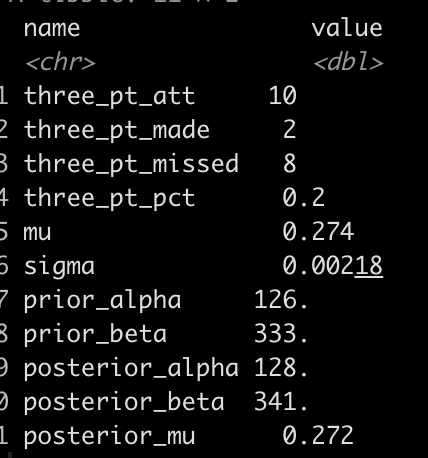
The new player took 10 three point shots, made 2, and has an observed 3pt% of 20%. Using our beta-binomial regression model we estimate the prior for a player with 10 attempts to be 0.274. Combining the prior with the 10 attempts we get a posterior 3pt% for the player of 0.272 (slightly below the average for the population of players who had 10 attempts).

Useful Resources

Some textbooks that I’ve found useful for exploring this type of work:

TidyX Episode 102: Normal-Normal Conjugate

So far we’ve covered the beta-binomial conjugate and the gamma-poisson conjugate. This week, Ellis Hughes and I discuss Bayesian analysis using the normal-normal conjugate. We build an example of a basketball player’s efficiency rating and show how to estimate their performance given prior knowledge of player efficiency ratings and some observed values from the player’s games.

To watch the screen cast, CLICK HERE.

To access our code, CLICK HERE.

Deriving a Confidence Interval from an Estimate and a p-value

Although most journals require authors to include confidence intervals into their papers it isn’t mandatory for all journal (merely a recommendation). Additionally, there may be occasions when you are reading an older paper from a time when this mandate/recommendation was not enforced. Finally, sometimes abstracts (due to word count limits) might only present p-values and estimates, in which case you might want to quickly obtain the confidence intervals to help organize your thoughts prior to diving into the paper. In these instances, you might be curious as to how you can get a confidence interval around the observed effect when all you have is a p-value.

Bland & Altman wrote a short piece of deriving confidence interval from only an estimate and a p-value in a 2011 paper in the British Medical Journal:

Altman, DG. Bland, JM. (2011). How to obtain the confidence interval from a p-value. BMJ, 343: 1-2.

Before going through the approach, it is important to note that they indicate a limitation of this approach is that it wont be as accurate in smaller samples, but the method can work well in larger studies (~60 subjects or more).

The Steps

The authors’ list 3 easy steps to derive the confidence interval from an estimate and p-value:

  1. Calculate the test statistic for a normal distribution from the p-value.
  2. Calculate the standard error (ignogre the minus sign).
  3. Calculate the 95% CI using the standard error and a z-critical value for the desired level of confidence.
  4. When doing this approach for a ratio (e.g., Risk Ratio, Odds Ratio, Hazard Ratio), the formulas should be used with the estimate on the log scale (if it already isn’t) and then exponentiate (antilog) the confidence intervals to put the results back to the normal scale.

Calculating the test statistic

To calculate the test statistic use the following formula:

z = -0.862 + sqrt(0.743 – 2.404 * log(p.value))

Calculating the standard error

To calculate the standard error use the following formula (remember that we are ignoring the sign of the estimate):

se = abs(estimate) / z

If we are dealing with a ratio, make sure that you are working on the log scale:

se = abs(log(estimate)) / z

Calculating the 95% Confidence Limits

Once you have the standard error, the 95% Confidence Limits can be calculated by multiplying the standard error by the z-critical value of 1.96:

CL.95 = 1.96 * se

From there, the 95% Confidence Interval can be calculated:

low95 = Estimate – CL.95
high95 = Estimate + CL.95

Remember, if you are working with rate statistics and you want to get the confidence interval on the natural scale, you will need to take the antilog:

low95 = exp(Estimate – CL.95)
high95 = exp(Estimate + CL.95)


Writing a function

To make this simple, I’ll write everything into a function. The function will take three arguments, which you will need to obtain from the paper:

  1. p-value
  2. The estimate (e.g., difference in means, risk ratio, odds ratio, hazard ratio, etc)

The function will default to log = FALSE but if you are working with a rate statistic you can change the argument to log = TRUE to get the results on both the log and natural scales. The function also takes a sig_digits argument, which defaults to 3 but can be changed depending on how many significant digits you need.

estimate_ci_95 <- function(p_value, estimate, log = FALSE, sig_digits = 3){
  
  if(log == FALSE){
    
    z <- -0.862 + sqrt(0.743 - 2.404 * log(p_value))
    z

    se <- abs(estimate) / z
    se
    
    cl <- 1.96 * se
    
    low95 <- estimate - cl
    high95 <- estimate + cl
    
    list('Standard Error' = round(se, sig_digits),
         '95% CL' = round(cl, sig_digits),
         '95% CI' = paste(round(low95, sig_digits), round(high95, sig_digits), sep = ", "))
    
  } else {
    
    if(log == TRUE){
      
      z <- -0.862 + sqrt(0.743 - 2.404 * log(p_value))
      z
      
      se <- abs(estimate) / z
      se
      
      cl <- 1.96 * se
      
      low95_log_scale <- estimate - cl
      high95_log_scale <- estimate + cl
      
      low95_natural_scale <- exp(estimate - cl)
      high95_natural_scale <- exp(estimate + cl)
      
      list('Standard Error (log scale)' = round(se, sig_digits),
           '95% CL (log scale)' = round(cl, sig_digits),
           '95% CL (natural scale)' = round(exp(cl), sig_digits),
           '95% CI (log scale)' = paste(round(low95_log_scale, sig_digits), round(high95_log_scale, sig_digits), sep = ", "),
           '95% CI (natural scale)' = paste(round(low95_natural_scale, sig_digits), round(high95_natural_scale, sig_digits), sep = ", "))
      
    }
    
  }
  
}

 Test the function out

The paper provides two examples, one for a difference in means and the other for risk ratios.

Example 1

Example 1 states:

“the abstract of a report of a randomised trial included the statement that “more patients in the zinc group than in the control group recovered by two days (49% v 32%,P=0.032).” The difference in proportions was Est = 17 percentage points, but what is the 95% confidence interval (CI)?

estimate_ci_95(p_value = 0.032, estimate = 17, log = FALSE, sig_digits = 1)


Example 2

Example 2 states:

“the abstract of a report of a cohort study includes the statement that “In those with a [diastolic blood pressure] reading of 95-99 mm Hg the relative risk was 0.30 (P=0.034).” What is the confidence interval around 0.30?”

Here we change the argument to log = TRUE since this is a ratio statistic needs to be on the log scale.

estimate_ci_95(p_value = 0.034, estimate = log(0.3), log = TRUE, sig_digits = 2)

Try the approach out on a different data set to confirm the confidence intervals are calculated properly

Below, we build a simple logistic regression model for the PimaIndiansDiabetes data set from the {mlbench} package.

  • The odds ratios are already on the log scale so we set the argument log = TRUE to ensure we get results reported back to us on the natural scale, as well.
  • We use the summary() function to obtain the model estimates and p-values.
  • We use the confint() function to get the 95% Confidence Intervals from the model.
  • To get the confidence intervals on the natural scale we also take the exponent, exp(confint()).
  • We use our custom function, estimate_ci_95(), to see how well the results compare.
## get data
library(mlbench)
data("PimaIndiansDiabetes")
df <- PimaIndiansDiabetes

## turn outcome variable into a numeric (0 = negative for diabetes, 1 = positive for diabetes)
df$diabetes_num <- ifelse(df$diabetes == "pos", 1, 0)
head(df)

## simple model
diabetes_glm <- glm(diabetes_num ~ pregnant + glucose + insulin, data = df, family = "binomial")

## model summary
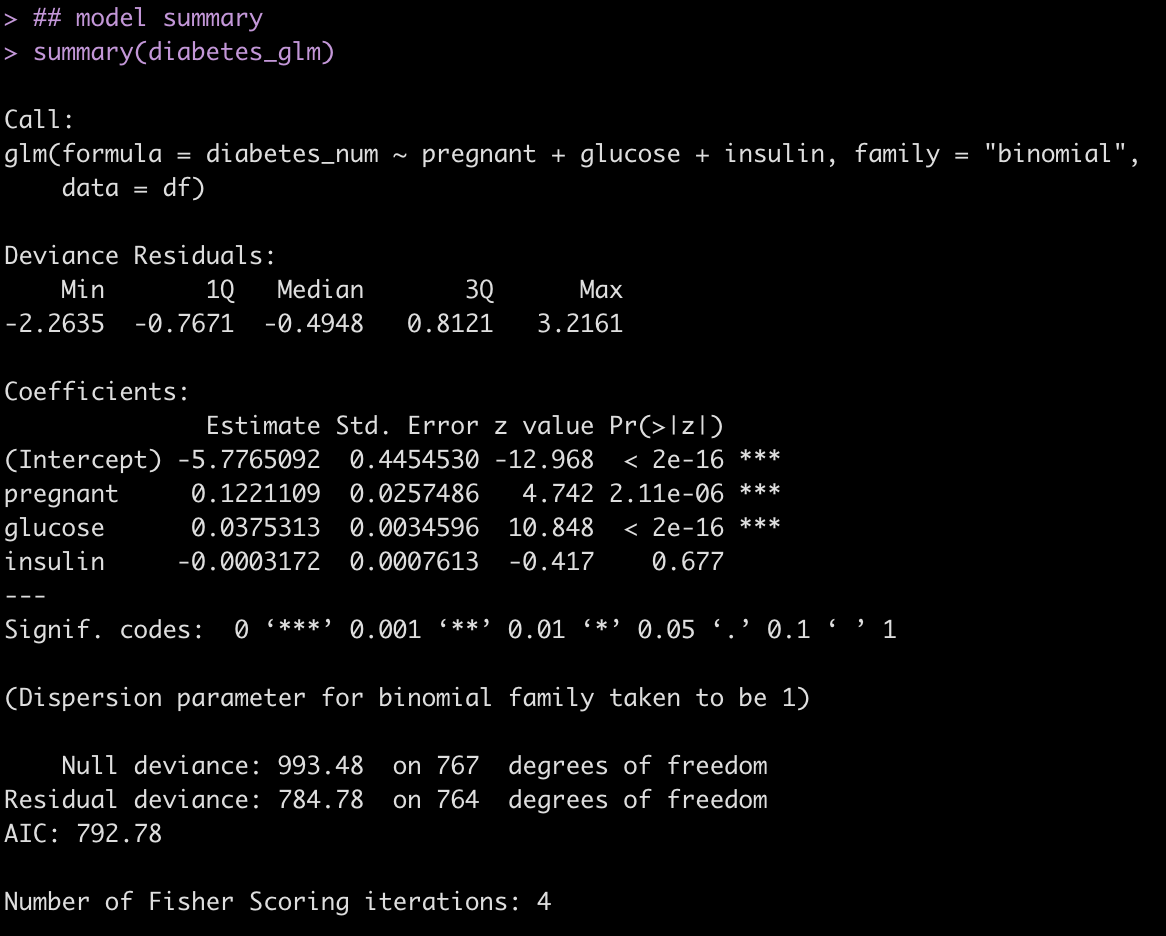
summary(diabetes_glm)


Calculate 95% CI from the p-values and odds ratio estimates.

Pregnant Coefficient

## 95% CI for the pregnant coefficient
estimate_ci_95(p_value = 2.11e-06, estimate = 0.122, log = TRUE, sig_digits = 3)


Glucose Coefficient

## 95% CI for the glucose coefficient
estimate_ci_95(p_value = 2e-16, estimate = 0.0375, log = TRUE, sig_digits = 3)


Insulin Coefficient

## 95% CI for the insulin coefficient
estimate_ci_95(p_value = 0.677, estimate = -0.0003, log = TRUE, sig_digits = 5)


Evaluate the results from the custom function to those calculated with the confint() function.

## Confidence Intervals on the Log Scale
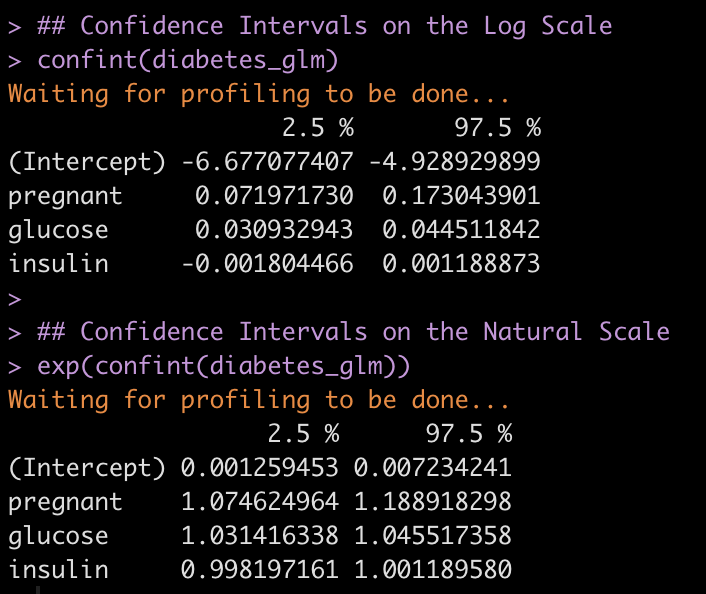
confint(diabetes_glm)

## Confidence Intervals on the Natural Scale
exp(confint(diabetes_glm))

We get nearly the same results with a bit of rounding error!

Hopefully this function will be of use to some people as they read papers or abstracts.

You can find the complete code in a cleaned up markdown file on my GITHUB page.

TidyX Episode 101: Gamma-Poisson Conjugate

This week Ellis Hughes and I continue to discuss Bayesian analysis and this time we transition to talking about count data. We build an example of using the gamma-poisson conjugate to take observations of a basketball players points per game and update our prior knowledge about the points per game for our given population.

To watch the screen cast, CLICK HERE.

To access the code, CLICK HERE.

Tyrese Maxey’s 3pt%, Bayes, Shrinkage

Some friends were discussing Philadelphia 76er’s point guard, Tyrese Maxey’s, three point% today. They were discussing how well he has performed over 72 games with a success rate of 43% behind the arc (at the time this data was scraped, 4/6/2022). While his percentage from 3pt range is very impressive I did notice that he has 294 attempts, which is less than 3 out of the 4 player’s that are ahead of him (Kyrie only has 214 attempts and he is ranked 3rd at the time of this writing) and Steph Curry is just behind Maxey in the ranking (42.4% success) with nearly 70 more attempts.

The question becomes, how can we be of Maxey’s three point percentage relative to those with more attempts? We will take a Bayesian approach, using a beta conjugate, to consider the success rate of these players relative to what we believe the average three point success rate is for an NBA shooter (our prior), which we will determine from observing 3 point shooting over previous 3 seasons.

NOTE: On basketball-reference.com, they have a nice check box that automatically will filter out players that are non-qualifiers for rate stats. After playing around with this, it appears that 200 attempts is their cut off. So, I will keep that and filter the data down to only those with 200 or more 3pt attempts.

All of the code, web scrapping, and csv files of the data (if you are looking to run it prior to when I scrapped it) are available on my GITHUB PAGE.

Exploratory Data Analysis

First, let’s view the top 10 three point shooters this season (size of the dot represents the number of three point attempts taken).

Visualize the distribution of three point attempts and three point% for the 2022 season, so far.

Establishing Our Prior

Since we are dealing with a binary outcome of successes (made the shot) and failures (missed the shot) we will use the beta distribution, which is the conjugate prior for the binomial distribution.

The beta distribution has two parameters, alpha and beta. To determine what these parameters should be, we will use the method of moments with the data from the previous three seasons.

To do this, we need to first find the mean and variance for the previous three seasons.

Next, we create a function that calculates alpha and beta based on the mean and variance from our observed data.

# function for calculating alpha and beta
beta_parameters <- function(dist_avg, dist_var){
  alpha <- dist_avg * (dist_avg * (1 - dist_avg)/dist_var - 1)
  beta <- alpha * (1 - dist_avg)/dist_avg
  list(alpha = alpha,
       beta = beta)
}


The function works to produce the two parameters we need. The data is returned in list format, so we will call each element of the list and store the respective values in their own variable.

The function works to produce the two parameters we need. The data is returned in list format, so we will call each element of the list and store the respective values in their own variable.


The alpha and beta parameters derived from our method of moments function appear to produce the mean and standard deviation correctly. We can plot this distribution to see what it looks like.

Update the 3pt% of the players in the 2022 season with our meta prior

We calculate our Bayes adjusted three point percentage for the players by adding their successes to `alpha` and their failures to `beta` and then calculating the new posterior percentage as

alpha / (alpha + beta)

and the posterior standard deviation as

sqrt((alpha * beta) / ((alpha + beta)^2 * (alpha + beta + 1)))

tbl2022 <- tbl2022 %>%
  mutate(three_pt_missed = three_pt_att - three_pt_made,
         posterior_alpha = three_pt_made + alpha,
         posterior_beta = three_pt_missed + beta,
         posterior_three_pt_pct = posterior_alpha / (posterior_alpha + posterior_beta),
         posterior_three_pt_sd = sqrt((posterior_alpha * posterior_beta) / ((posterior_alpha + posterior_beta)^2 * (posterior_alpha + posterior_beta + 1))))

Have any of the players in the top 10 changes following in the adjustment?

  • We see that Desmond Bane has jumped Kyrie, who only had 214 attempts. Kyrie dropped from 3rd to 6th.
  • Tyrese Maxey moves up one spot to 4.
  • Grant Williams drops out of the top 10 while Tyrese Haliburton moves up into the top 10

We can plot the results of these top 10 players showing the posterior Bayes three point% relative to their observed three point%.

Show the uncertainty in Tyrese Maxies Performance versus Luke Kennard, who has 409 attempts

kennard <- tbl2022 %>%
  filter(player == "Luke Kennard")

maxey <- tbl2022 %>%
  filter(player == "Tyrese Maxey")

plot(density(rbeta(n = 1e6, shape1 = maxey$posterior_alpha, shape2 = maxey$posterior_beta)),
     col = "blue",
     lwd = 4,
     ylim = c(0, 20),
     xlab = "3pt %",
     main = "Bayes Adjusted 3pt%\nBlue = Tyrese Maxey | Red = Luke Kennard")
lines(density(rbeta(n = 1e6, shape1 = kennard$posterior_alpha, shape2 = kennard$posterior_beta)),
      col = "red",
      lwd = 4)

If we sample from the posterior for both players, how much better is Kennard?

maxey_sim <- rbeta(n = 1e6, shape1 = maxey$posterior_alpha, shape2 = maxey$posterior_beta)

kennard_sim <- rbeta(n = 1e6, shape1 = kennard$posterior_alpha, shape2 = kennard$posterior_beta)

plot(density(kennard_sim - maxey_sim),
     lwd = 4,
     col = "black",
     main = "Kennard Posterior Sim - Maxie Posterior Sim",
     xlab = "Difference between Kennard & Maxie")
abline(v = 0,
       lwd = 4,
       lty = 2,
       col = "red")

On average, Kennard was better in ~74% of the 1,000,000 simulations.

Long story short, Tyrese Maxey has been a solid 3pt shooter, he just happens to play on a team where James Harden takes many of the shots (maybe he should distribute the ball more?).

One last thing…..Shrinkage

So, what happened? Basically, the Bayesian adjustment created “shrinkage” whereby the players that are above average are pulled down slightly towards the population average and the players below average are pulled up slightly towards the population average. The amount of shrinkage depends on the number of attempts the player has had (the size of their sample). More attempts leads to less shrinkage (more certainty about their performance) and smaller attempts leads to more shrinkage (more certainty about their). Basically, if we haven’t seen you shoot very much then our best guess is that you are probably closer to average until we are provided more evidence to believe otherwise.

Since we were originally dealing with only players that have had 200 or more three point attempts, let’s scrape all players from the 2022 season and apply the same approach to see what shrinkage looks like.

url2022 <- read_html("https://www.basketball-reference.com/leagues/NBA_2022_totals.html")

tbl2022a <- html_nodes(url2022, 'table') %>%
  html_table(fill = TRUE) %>%
  pluck(1) %>%
  janitor::clean_names() %>%
  select("player", three_pt_att = "x3pa", three_pt_made = "x3p", three_pt_pct = "x3p_percent") %>%
  filter(player != "Player") %>%
  mutate(across(.cols = three_pt_att:three_pt_pct,
                ~as.numeric(.x))) %>%
  filter(!is.na(three_pt_pct)) %>%
  arrange(desc(three_pt_pct)) %>%
  mutate(three_pt_missed = three_pt_att - three_pt_made,
         posterior_alpha = three_pt_made + alpha,
         posterior_beta = three_pt_missed + beta,
         posterior_three_pt_pct = posterior_alpha / (posterior_alpha + posterior_beta),
         posterior_three_pt_sd = sqrt((posterior_alpha * posterior_beta) / ((posterior_alpha + posterior_beta)^2 * (posterior_alpha + posterior_beta + 1))))


tbl2022a %>%
  mutate(pop_avg = alpha / (alpha + beta)) %>%
  ggplot(aes(x = three_pt_pct, y = posterior_three_pt_pct, size = three_pt_att)) +
  geom_point(color = "black",
             alpha = 0.8) +
  geom_hline(aes(yintercept = pop_avg),
             color = "green",
             size = 1.2,
             linetype = "dashed") +
  geom_abline(intercept = 0,
              slope = 1,
              size = 1.2,
              color = "green") +
  labs(x = "Observed 3pt%",
       y = "Bayesian Adjusted 3pt%",
       size = "Attempts",
       title = "Shirnkage of 3pt% using Beta-Conjugate",
       caption = "Data Source: https://www.basketball-reference.com/leagues/NBA_2022_totals.html")

What does this tell us?

  • Points closest to the diagonal line (the line of equality — points on this line represent 0 difference between Bayes adjusted and Observed 3pt%) see much almost no shrinkage towards the observed 3pt%.
  • Notice that the points nearest the line also have tend to be larger, meaning we have more observations are more certainty of that player’s true skill.
  • The horizontal dashed line represents the population average (determined from the alpha and beta parameters obtained from previous 3 seasons).
  • Notice that the smaller points (less observations) get shrunk towards this line given we haven’t seen enough from that player to believe differently. For example, the tiny dot to the far right indicates the player has an observed 3pt% of 100%, which we wouldn’t really believe to be sustainable for the full season (maybe the player took one or two shots and got lucky?). So that point is pulled downwards towards the dashed line as our best estimate is that the player ie closer to an average shooter.