Author Archives: Patrick

Displaying Performance Outcomes on a Test

Introduction

I recently had a discussion with some colleagues about displaying performance outcomes on a test for a group of athletes. The discussion was centered around percentile ranking the athletes on a team within a given season. While is one way to display such information we could alternatively display the data as a percentile using a known mean and standard deviation for the population. This latter approach works by standardizing the data (z-score) and using properties of the normal distribution. Similarly, we could take the z-score and convert it to a t-score, on a 1-100 score.

Given these different options, I figured I’d throw together a quick article to show what they look like and how to calculate them in R. The discussion is right in line with the last 2 blog articles about using boxplots and dotplots to visualize athlete testing data (Part 1 and Part 2).

Simulate Data

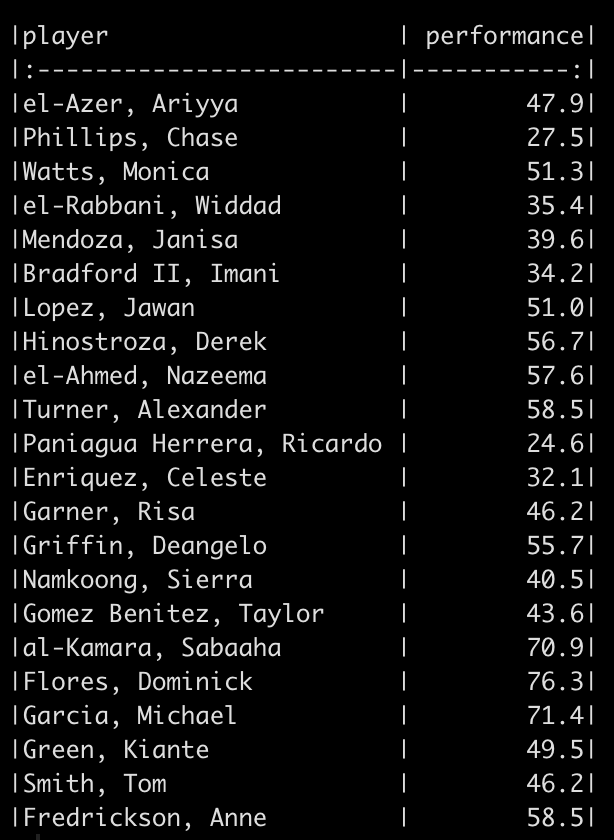
We will simulate performance test results for 22 different athletes. To do this, we take advantage of the rnorm() function in R and draw from 3 different normal distributions to produce 20 tests results. Since I used set.seed() you will be able to reproduce my results exactly. After creating 20 simulations I added 2 additional athletes to the data set and gave them test scores that were exactly the same as two other athletes in the data so that we had some athletes with the same performance outcome.
Percentile Rank

The percentile rank reflects the percentage of observations that are below a certain score. This value is displayed in 100 theoretical divisions of the observed data. Thus, the top score in the data represents 100 and every value falls below that.

To calculate the percentile rank we simply rank the observed performance values and then divide by the number of observations.

Let’s start by sorting the performance scores so that they are in order from lowest to highest.

Next, we rank these values.

Notice that when we sort the data we see that the values 58.5 and 46.2 are repeated twice. Once we rank them we see that the rank values are also correctly repeated. We can get rid of the half points for these repeated observation by using the trunc() function, which will truncate the values.

Finally, to get the percentile rank, we divide by the total number of observations.

Instead of always having to walk through these steps, we can create a function to do the steps for us in one line of code. This will come in handy when we compare all of these methods later on.

perc.rank <- function(x){
  trunc(rank(x))/length(x)
}

perc.rank(sort(df$performance))

Percentiles

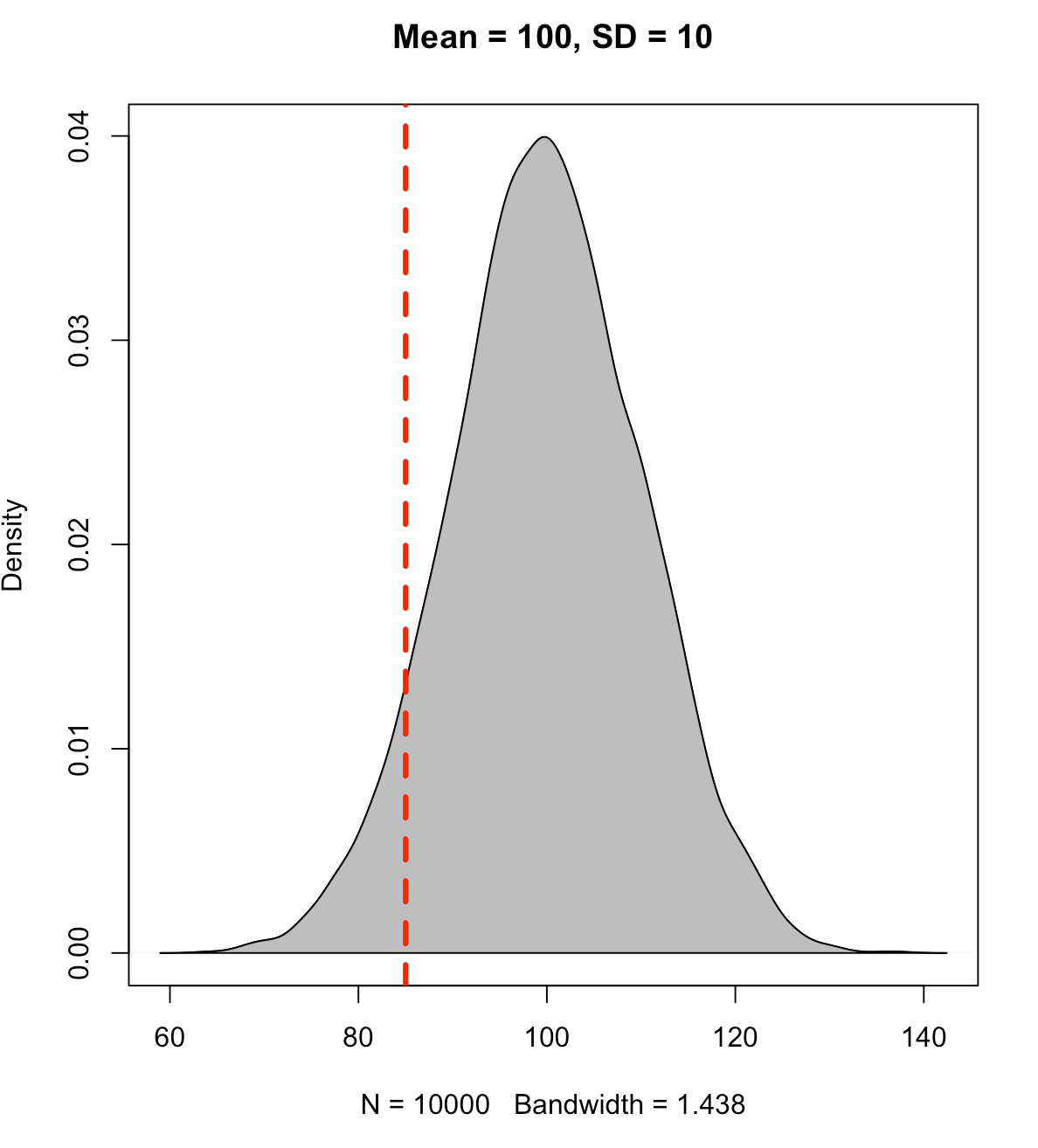
A percentile value is different than a percentile rank in that the percentile value reflects the observed score relative to a population mean and standard deviation. Often, this type of value has been used to represent how well a student has performed on a standardized test (e.g., SAT, ACT, GRE, etc.). The percentile value tells us the density of values below our observation. Thus, the percentile value represents a cumulative distribution under the normal curve, below the point of interest. For example, let’s say we have a bunch of normally distributed data with a mean of 100 and standard deviation of 10. If we plot the distribution of the data and drop a line at 100 (the mean), 50% of the data will fall below and it 50% above it.

set.seed(1)
y <- rnorm(n = 10000, mean = 100, sd = 10)

plot(density(y), col = 'black',
  main = 'Mean = 100, SD = 10')
polygon(density(y), col = 'grey')
abline(v = 100, col = 'red', lty = 2, lwd = 3)
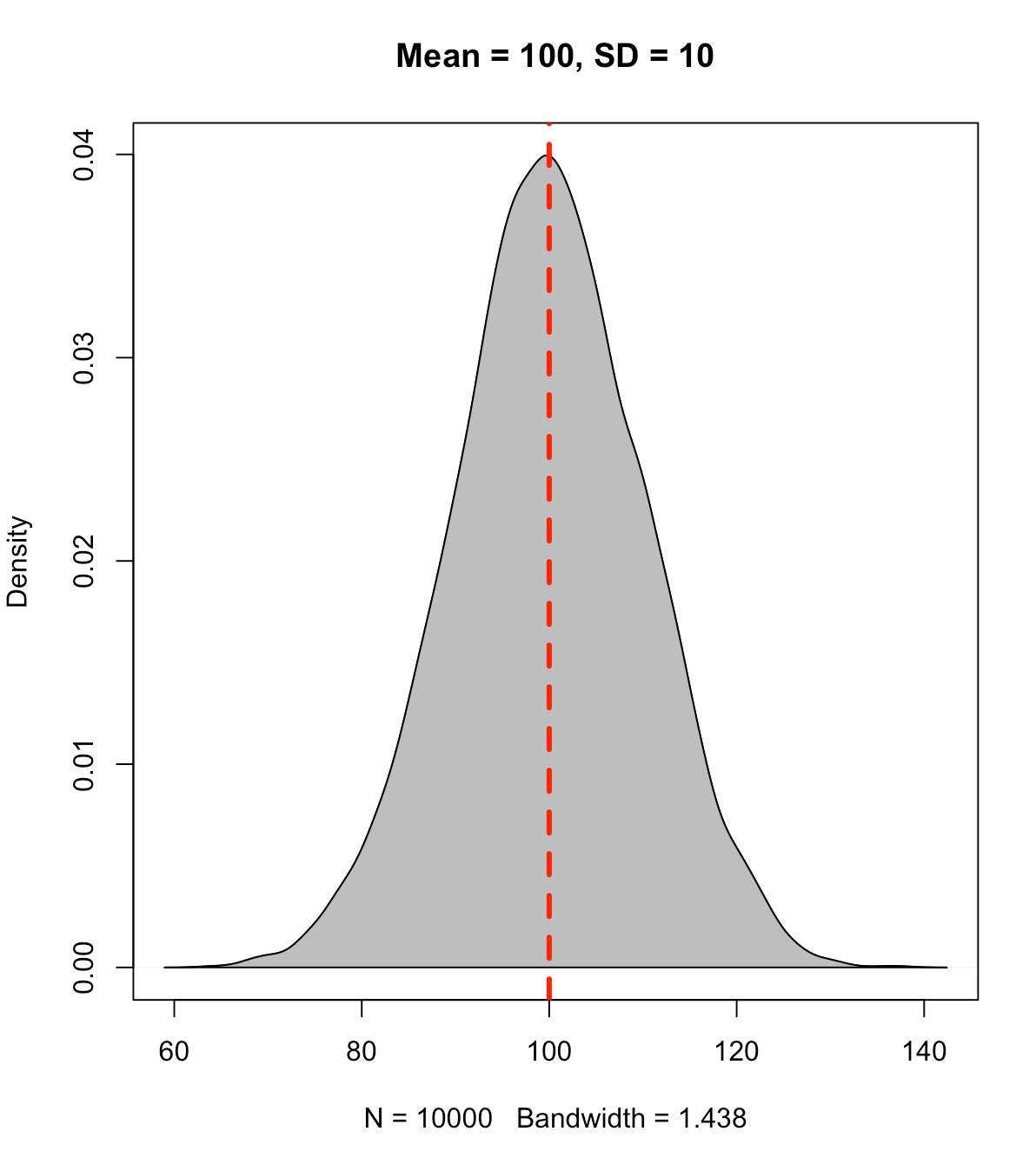
Instead, if we place the line at an observation of 85 we will see that approximately 7% of the data falls below this point (conversely, 93% of the data is above it).
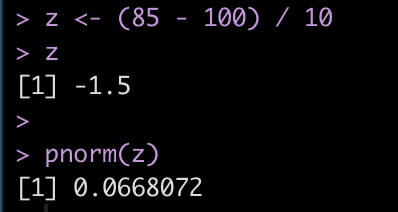
To find the cumulative distribution below a specific observation we can use the pnorm() function and pass it the observation of interest, the population mean, and the standard deviation.

Alternatively, we can obtain the same value by first calculating the z-score of the point of interest and simply passing that into the pnorm() function.

z = (observation – mean) / sd

We find that the z-score for 85 is -1.5 standard deviations below the mean.
We will write a z-score function to use later on.

z_score <- function(x, avg, SD){
  z = (x - avg) / SD
  return(z)
}

T-score

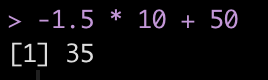
As we saw above, the score of 85 led to a z-score of -1.5. Sometimes having the data scaled to a mean of 0 with values above and below it can difficult for decision-makers to interpret. As such, we can take the z-score and turn it into a a t-score, ranging from 0-100, where 50 represents average, 40 and 60 represent ± 1 standard deviation, 30 and 70 represent ± 2 standard deviation, and 20 and 80 represent ± 3 standard deviations from the mean.

t = observation*10 + 50

Therefore, using the z-score value of -1.5 we end up with a t-score of 35.
We will make a t-score function to use on our athlete simulated data.

t_score <- function(z){
  t = z * 10 + 50
  return(t)
}

Returning to the athlete simulated data

We now return to our athlete simulated data and apply all of these approaches to the performance data. For the z-score, t-score, and percentile values, I’ll start by using the mean and standard deviation of the observed data we have.

df_ranks_v1 <- df %>%
  mutate(percentile_rank = perc.rank(performance),
         percentile_value = pnorm(performance, mean = mean(performance), sd = sd(performance)),
         z = z_score(x = performance, avg = mean(performance), SD = sd(performance)),
         t = t_score(z)) %>%
  mutate(across(.cols = percentile_rank:t,
                ~round(.x, 2)))

df_ranks_v1 %>% 
  arrange(desc(percentile_rank)) %>%
  knitr::kable()

We can also plot these values to provide ourselves a visual to compare them.
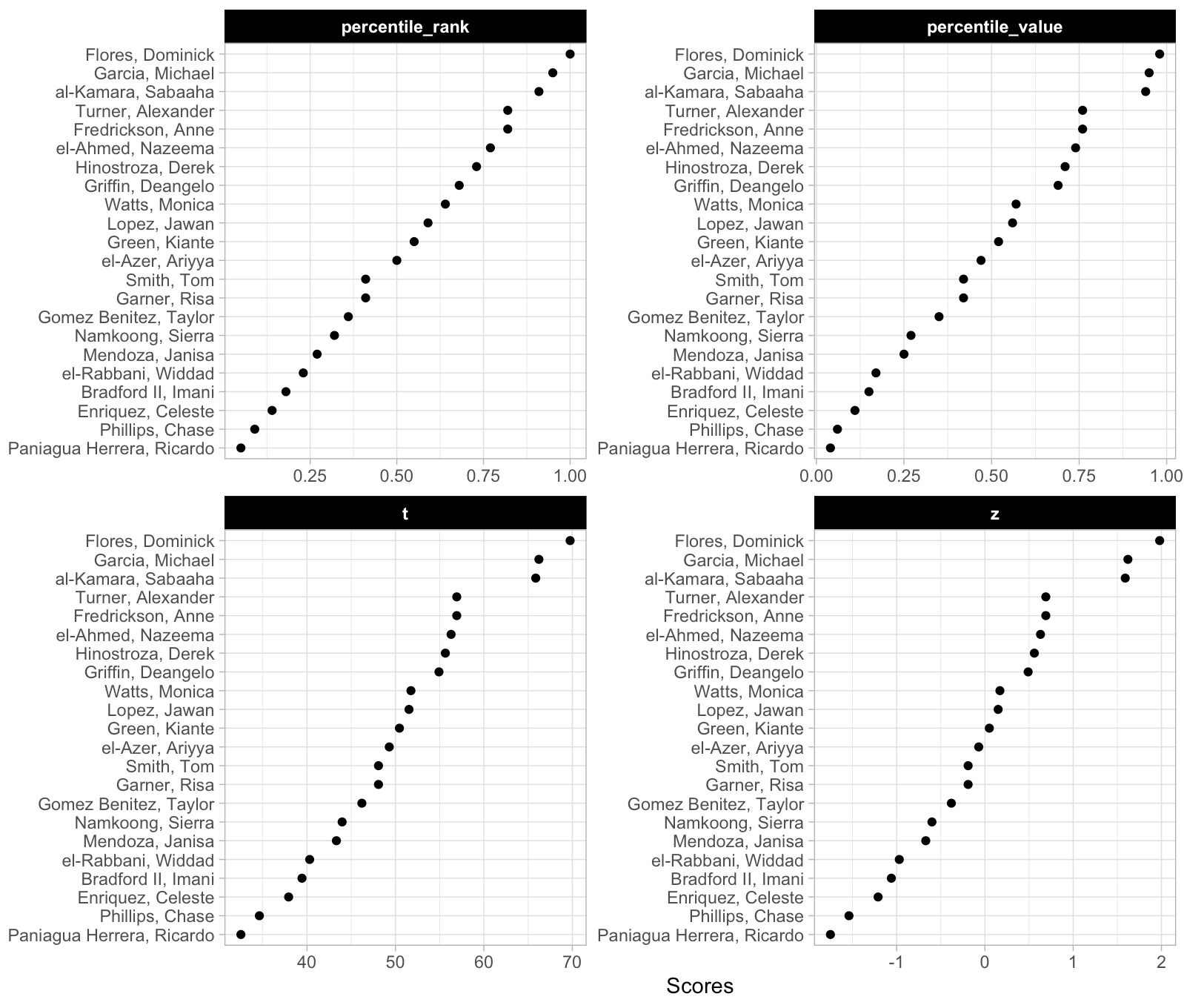
We can see that the order of the athletes doesn’t change based on the method. This makes sense given that the best score for this group of athletes is always going to be the best score and the worst will always be the worst. We do see that the percentile rank approach assigns the top performance as 100%; however, the percentile value assigns the top performance a score of 98%. This is because the percent value is based on the parameters of the normal distribution (mean and standard deviation) and doesn’t rank the observations from best to worse as the percentile rank does. Similarly, the other two scores (z-score and t-score) also use the distribution parameters and thus follow the same pattern as the percentile value.

Why does this matter? The original discussion was about athletes within a given season, on one team. If all we care about is the performance of that group of athletes, on that team, in that given season, then maybe it doesn’t matter which approach we use. However, what if we want to compare the group of athletes to previous teams that we’ve had or to a population mean and standard deviation that we’ve obtained from the league (or from scientific literature)? In this instance, the percentile rank value will remain unchanged but it will end up looking different than the other three scores because it doesn’t depend on the mean and standard deviation of the population.

For example, the mean and standard deviation of our current team is 48.9 ± 13.9.
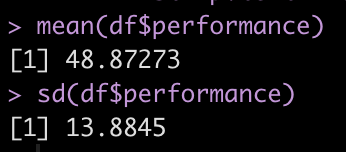
Perhaps our team is currently below average for what we expect from the population. Let’s assume that the population we want to compare our team to has a mean and standard of 55 ± 10.

df_ranks_v2 <- df %>%
  mutate(percentile_rank = perc.rank(performance),
         percentile_value = pnorm(performance, mean = 55, sd = 10),
         z = z_score(x = performance, avg = 55, SD = 10),
         t = t_score(z)) %>%
  mutate(across(.cols = percentile_rank:t,
                ~round(.x, 2)))

df_ranks_v2 %>% 
  arrange(desc(percentile_rank)) %>%
  knitr::kable()
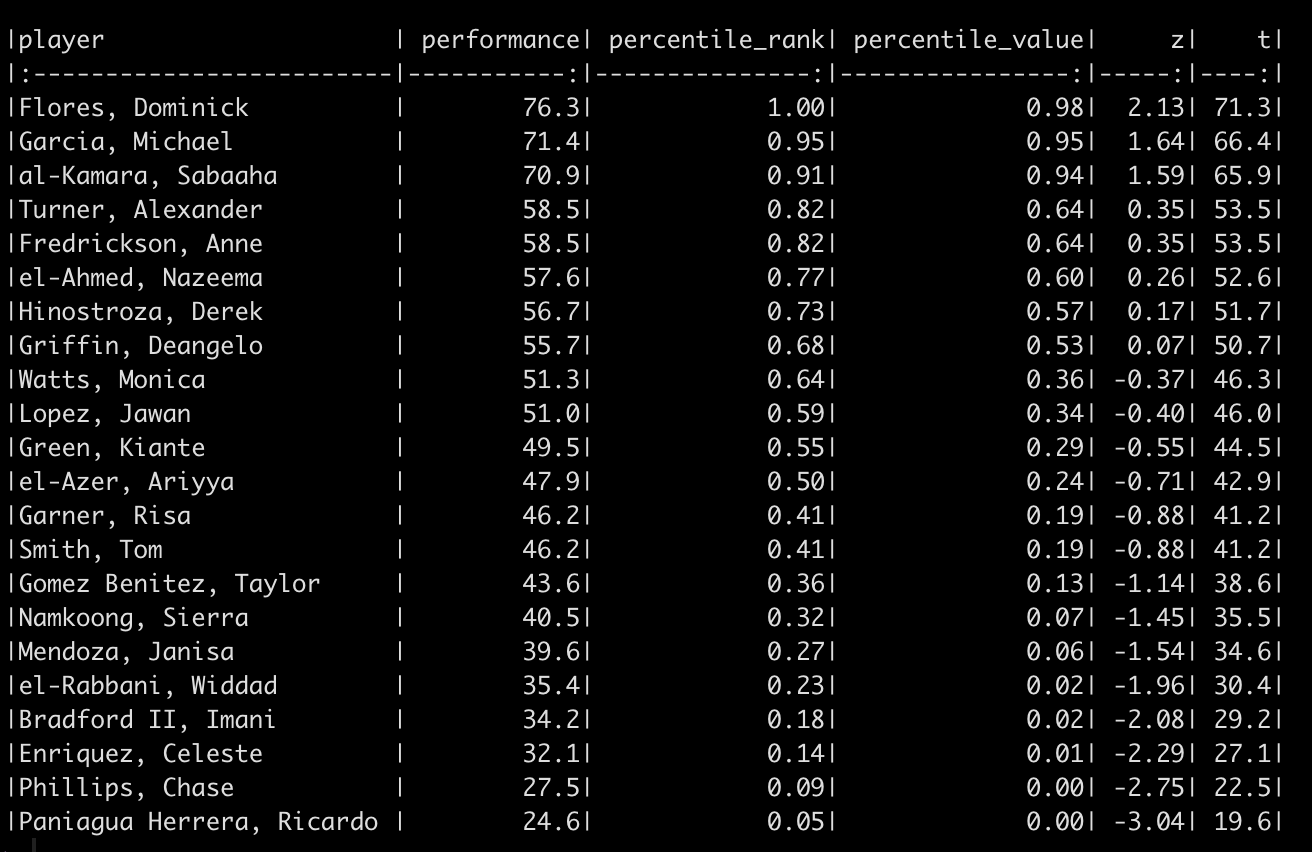
Again, the order of the athletes’ performance doesn’t change and thus the percentile rank of the athletes also doesn’t change. However, the percentile values, z-scores, and t-scores now tell a different story. For example, el-Azer, Ariyya scored 47.9 which has a percentile rank of 50% for the observed performance scores of this specific team. However, this value relative to our population of interest produces a z-score of -0.71, a t-score of 42.9, and a percentile value indicating that only 24% of those in the population who are taking this test are below this point. The athlete looks to be average for the team but when compared to the population they look to be below average.

Wrapping Up

There are a number of ways to display the outcomes on a test for athletes. Using percentile rank, we are looking specifically at the observations of the group that took the given test. If we use percentile value, z-scores, and t-scores, we are using properties of the normal distribution and, often comparing the observed performance to some known population norms. There probably isn’t a right or wrong approach here. Rather, it comes down to the type of story you are looking to tell with your data.

The full code for this article is available on my GITHUB page.
Box & Dotplots for Performance Visuals – Creating an Interactive Plot with plotly

Yesterday, I provided some code to make a simple boxplot with doplot in order to visualize an athlete’s performance relative to their peers.

Today, we will try and make this plot interactive. To do so, we will use the {plotly} package and save the plots as html files that can be sent to our coworkers or decision-makers so that they can interact directly with the data.

Data

We will use the same simulated data from yesterday and also load the {plotly} library.

### Load libraries -----------------------------------------------
library(tidyverse)
library(randomNames)
library(plotly)

### Data -------------------------------------------------------
set.seed(2022)
dat <- tibble( participant = randomNames(n = 20), performance = rnorm(n = 20, mean = 100, sd = 10)) 

Interactive plotly plot

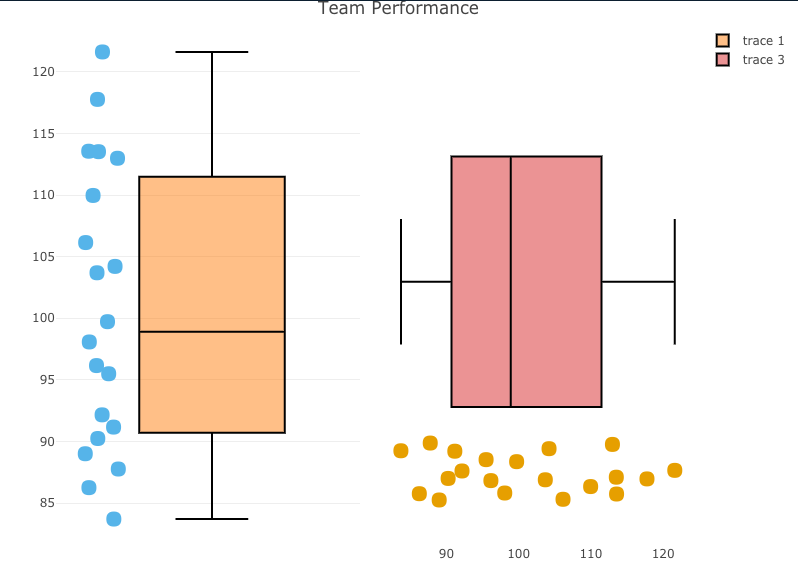
Our first two plots will be the same, one vertical and one horizontal. Plotly is a little different than ggplot2 in syntax.

  • I start by creating a base plot, indicating I want the plot to be a boxplot. I also tell plotly that I want to group by participant, so that the dots will show up alongside the boxplot, as they did in yesterday’s visual.
  • Once I’ve specified the base plot, I indicate that I want boxpoints to add the points next to the boxplot and set some colors (again, using a colorblind friendly palette)
  • Finally, I add axis labels and a title.
  • For easy, I use the subplot() function to place the two plots next to each other so that you can compare the vertical and horizontal plot and see which you prefer.
### Build plotly plot -------------------------------------------
# Set plot base
perf_plt <- plot_ly(dat, type = "box") %>%
  group_by(participant)

# Vertical plot
vert_plt <- perf_plt %>%
  add_boxplot(y = ~performance,
              boxpoints = "all",
              line = list(color = 'black'),
              text = ~participant,
              marker = list(color = '#56B4E9',
                            size = 15)) %>% 
  layout(xaxis = list(showticklabels = FALSE)) %>%
  layout(yaxis = list(title = "Performance")) %>%
  layout(title = "Team Performance")       

# Horizontal plot
hz_plt <- perf_plt %>%
  add_boxplot(x = ~performance,
              boxpoints = "all",
              line = list(color = 'black'),
              text = ~participant,
              marker = list(color = '#E69F00',
                            size = 15)) %>% 
  layout(yaxis = list(showticklabels = FALSE)) %>%
  layout(xaxis = list(title = "Performance")) %>%
  layout(title = "Team Performance") 

## put the two plots next to each other
subplot(vert_plt, hz_plt)


  • Statically, we can see the plot below and if you click on the red link beneath it you will be taken to the interactive version, where you can hover over the points and see the individual athlete’s name and performance on the test.

interactive_plt1


Interactive plotly with selector option

Next, we build the same plot but add a selector box so that the user can select the individual of interest and see their point relative to the boxplot (the population data).

This approach requires a few steps:

  • I have to create a highlight key to explicitly tell plotly that I want to be able to highlight the participants.
  • Next I create the base plot but this time instead of using the original data, I pass in the highlight key that I created in step 1.
  • I build the plot just like before.
  • Once the plot has been built I use the highlight() function to tell plotly how I want the plot to behave.

NOTE: This approach is super useful and easy and doesn’t require a shiny server to share the results. That said, I find this aspect of plotly to be a bit clunky and, when given the choice between this or using shiny, I take shiny because it has a lot more options to customize it exactly how you want. The downside is that you’d need a shiny server to share your results with colleagues or decision-makers, so there is a trade off.

### plotly with selection box -------------------------------------------
# set 'particpant' as the group to select
person_of_interest <- highlight_key(dat, ~participant)

# create a new base plotly plot using the person_of_interest_element
selection_perf_plt <- plot_ly(person_of_interest, type = "box") %>%
  group_by(participant)

# build the plot
plt_selector <- selection_perf_plt %>%
  group_by(participant) %>%
  add_boxplot(x = ~performance,
              boxpoints = "all",
              line = list(color = 'black'),
              text = ~participant,
              marker = list(color = '#56B4E9',
                            size = 15)) %>% 
  layout(yaxis = list(showticklabels = FALSE)) %>%
  layout(xaxis = list(title = "Performance")) %>%
  layout(title = "Team Performance")   

# create the selector tool
plt_selector %>%
  highlight(on = 'plotly_click',
              off = 'plotly_doubleclick',
              selectize = TRUE,
              dynamic = TRUE,
              persistent = TRUE)


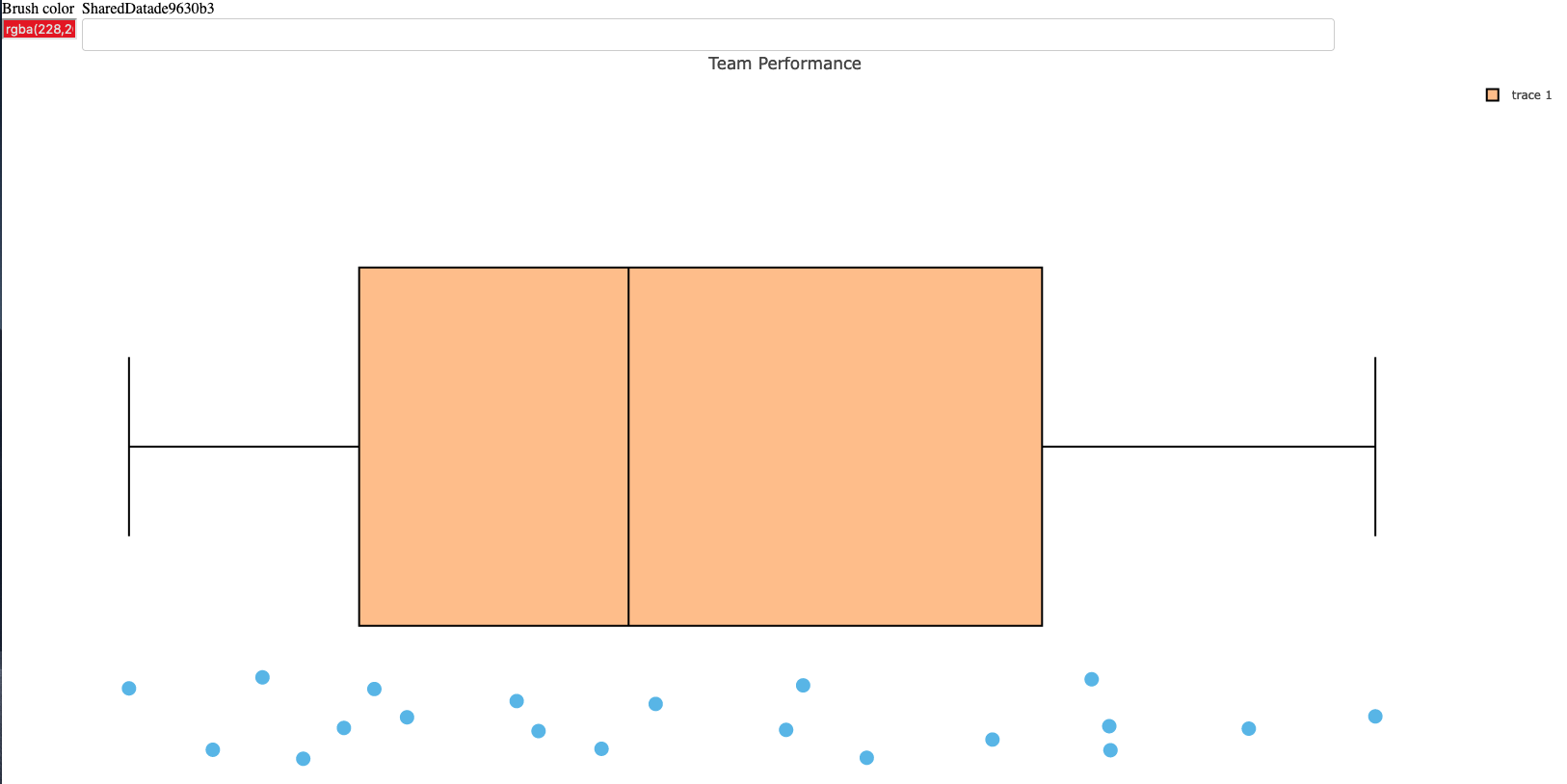
  • Statically, we can see what the plot looks like below.
  • Below the static image you can click the red link to see me walk through the interactive plot. Notice that as I select participants it selects them out. I can add as many as I want and change color to highlight certain participants over others. Additionally, once I begin to remove participants you’ll notice that plotly will create a boxplot for the selected sub population, which may be useful when communicating performance results.
  • Finally, the last red link will allow you to open the interactive tool yourself and play around with it.

interactive_plt2_video

interactive_plt2

Wrapping Up

Today’s article provided some interactive options for the static plots that were created in yesterday’s blog article.

As always, the complete code for this article is available on my GITHUB page.
Box & Dotplots for Performance Visuals

A colleague recently asked me about visualizing athlete performance of athletes relative to their teammates. More specifically, they wanted something that showed some sort of team average and normal range and then a way to highlight where the individual athlete of interest resided within the population.

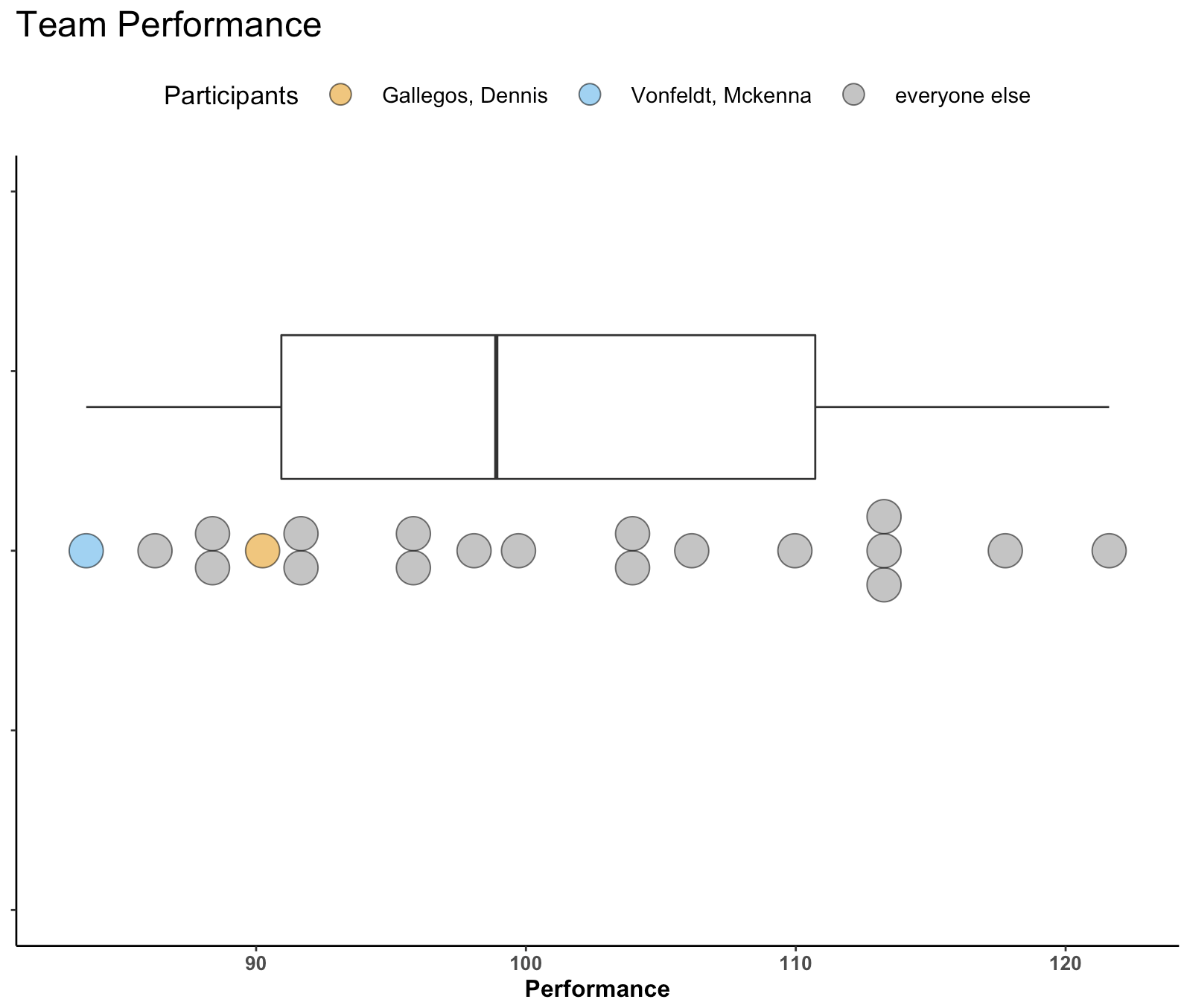
Immediately, my mind went to some type of boxplot visualization combined with a dotplot where the athlete can clearly identified. Here are a few examples I quickly came up with.

Simulate Performance Data

First we will simulate some performance data for a group of athletes.

### Load libraries -----------------------------------------------
library(tidyverse)
library(randomNames)

### Data -------------------------------------------------------
set.seed(2022)
dat <- tibble(
  participant = randomNames(n = 20),
  performance = rnorm(n = 20, mean = 100, sd = 10))

Plot 1 – Boxplot with Points

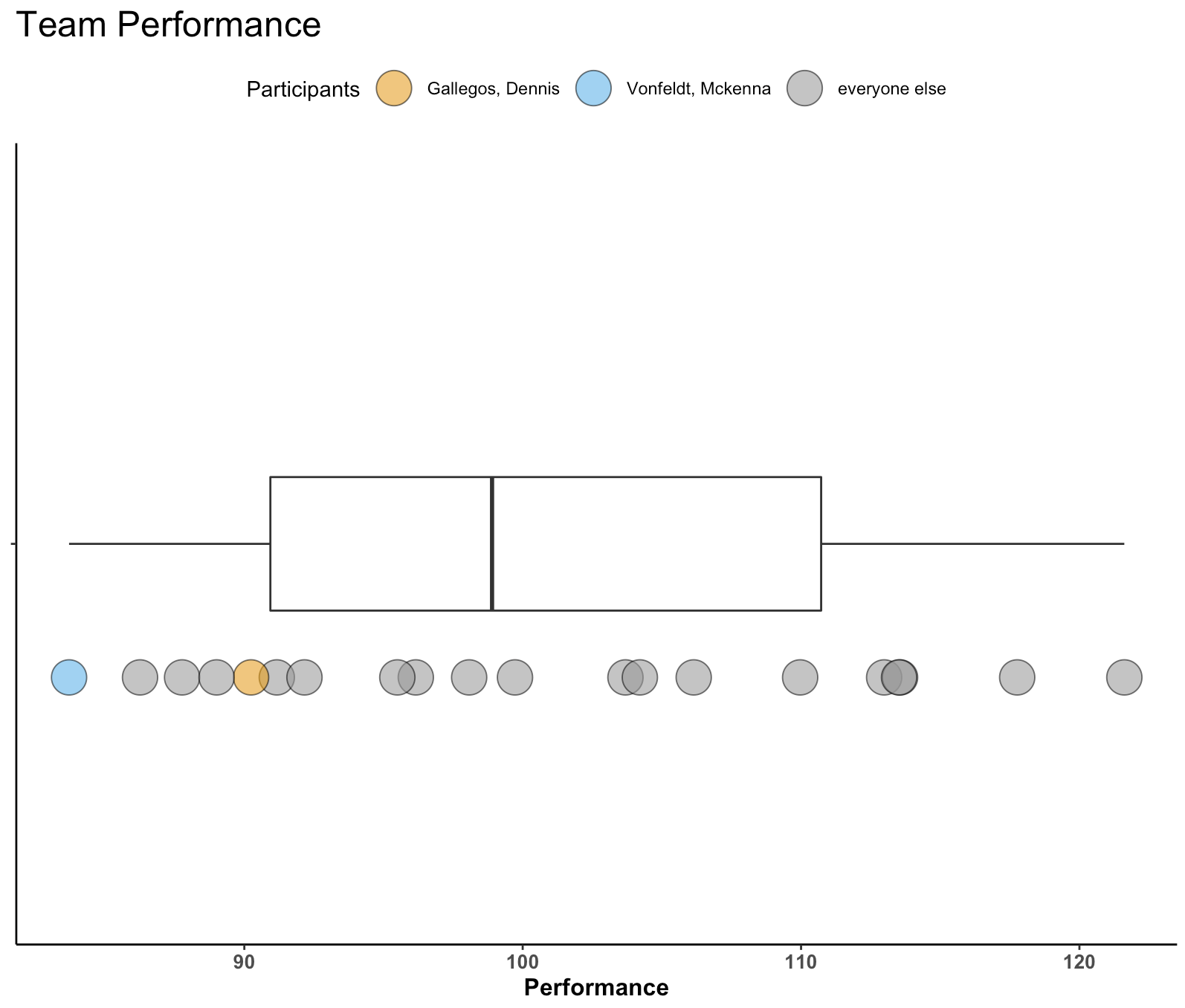
The first plot is a simple boxplot plot with dots below it.

A couple of notes:

  • I’ve selected a few athletes to be our “of_interest” players for the plot.
  • This plot doesn’t have a y-axis, since all I am doing is plotting the boxplot for the distribution of performance. Therefore, I set the y-axis variable to a factor, so that is simply identifies a space within the grid to organize my plot.
  • I’m using a colorblind friendly palette to ensure that the colors are viewable to a broad audience.
  • Everything else after that is basic {ggplot2} code with some simple theme styling for the plot space and the legend position.
dat %>%
  mutate(of_interest = case_when(participant %in% c("Gallegos, Dennis", "Vonfeldt, Mckenna") ~ participant,
                                 TRUE ~ "everyone else")) %>%
  ggplot(aes(x = performance, y = factor(0))) +
  geom_boxplot(width = 0.2) +
  geom_point(aes(x = performance, y = factor(0),
                  fill = of_interest),
              position = position_nudge(y = -0.2),
              shape = 21,
              size = 8,
              color = "black",
              alpha = 0.6) +
  scale_fill_manual(values = c("Gallegos, Dennis" = "#E69F00", "Vonfeldt, Mckenna" = "#56B4E9", "everyone else" = "#999999")) +
  labs(x = "Performance",
       title = "Team Performance",
       fill = "Participants") +
  theme_classic() +
  theme(axis.text.y = element_blank(),
        axis.title.y = element_blank(),
        axis.text.x = element_text(size = 10, face = "bold"),
        axis.title.x = element_text(size = 12, face = "bold"),
        plot.title = element_text(size = 18),
        legend.position = "top")

Not too bad! You might have more data than we’ve simulated and thus the inline dots might start to get busy. We can use geom_dotplot() to create separation between dots in areas where there is more density and expose that density of performance scores a bit better.

Plot 2 – Boxplot with Dotplots

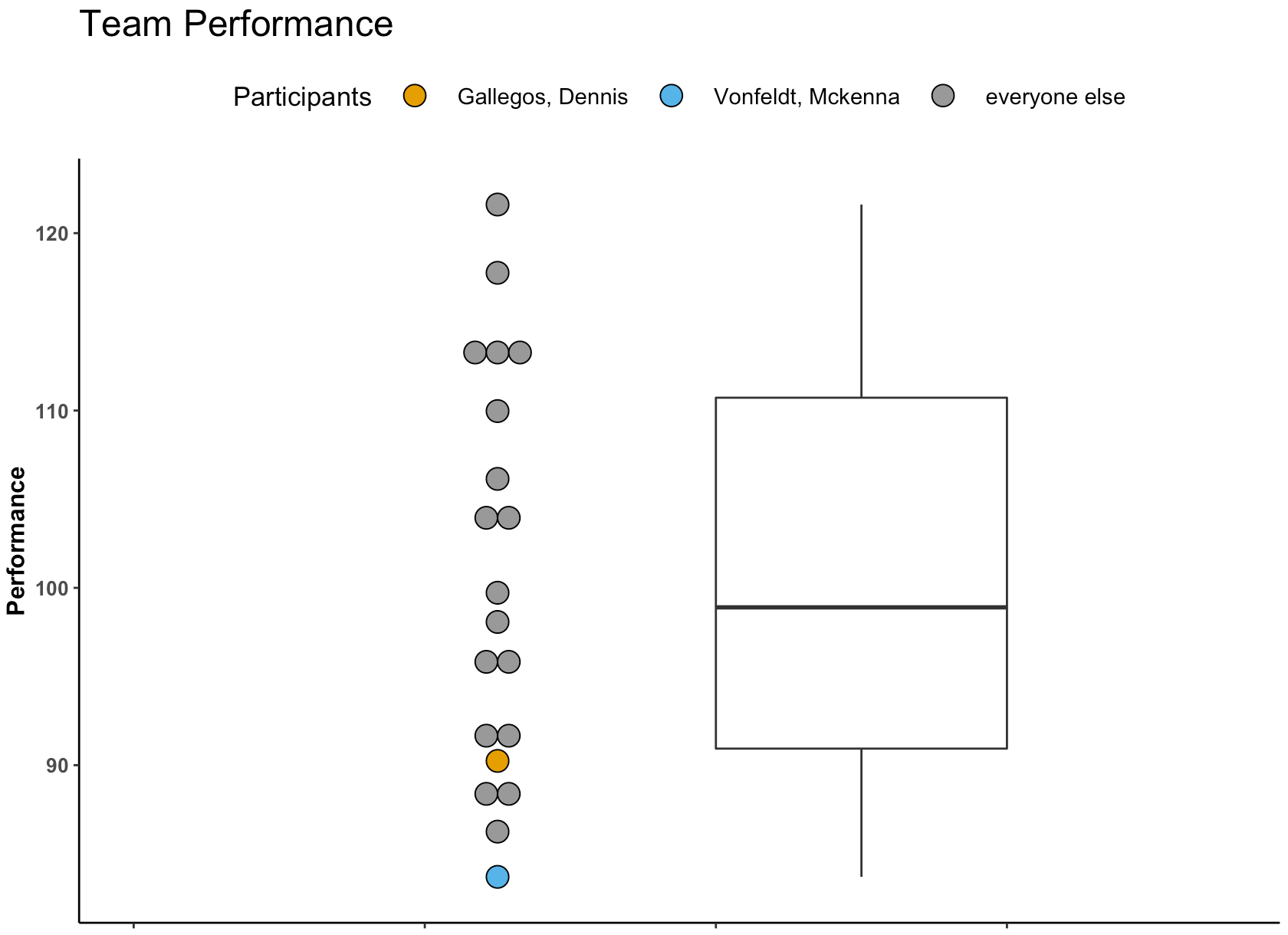
Swapping out geom_point() with geom_dotplot() allows us to produce the same plot above just with a dotplot.

  • Here, I set “y = positional” since, as before, we don’t have a true y-axis. Doing so allows me to specify where on the y-axis I want to place by boxplot and dotplot in their respective aes().
# Horizontal
dat %>%
  mutate(of_interest = case_when(participant %in% c("Gallegos, Dennis", "Vonfeldt, Mckenna") ~ participant,
                                 TRUE ~ "everyone else")) %>%
  ggplot(aes(x = performance, y = positional)) +
  geom_boxplot(aes(y = 0.2),
    width = 0.2) +
  geom_dotplot(aes(y = 0, 
                   fill = of_interest),
              color = "black",
              stackdir="center",
              binaxis = "x",
              alpha = 0.6) +
  scale_fill_manual(values = c("Gallegos, Dennis" = "#E69F00", "Vonfeldt, Mckenna" = "#56B4E9", "everyone else" = "#999999")) +
  labs(x = "Performance",
       title = "Team Performance",
       fill = "Participants") +
  theme_classic() +
  theme(axis.text.y = element_blank(),
        axis.title.y = element_blank(),
        axis.text.x = element_text(size = 10, face = "bold"),
        axis.title.x = element_text(size = 12, face = "bold"),
        plot.title = element_text(size = 18),
        legend.position = "top",
        legend.title = element_text(size = 13),
        legend.text = element_text(size = 11),
        legend.key.size = unit(2, "line")) 

If you don’t like the idea of a horizontal plot you can also do it in vertical.

# vertical
dat %>%
  mutate(of_interest = case_when(participant %in% c("Gallegos, Dennis", "Vonfeldt, Mckenna") ~ participant,
                                 TRUE ~ "everyone else")) %>%
  ggplot(aes(x=positional, y= performance)) +
  geom_dotplot(aes(x = 1.75, 
                   fill = of_interest), 
               binaxis="y", 
               stackdir="center") +
  geom_boxplot(aes(x = 2), 
               width=0.2) +
  scale_fill_manual(values = c("Gallegos, Dennis" = "#E69F00", "Vonfeldt, Mckenna" = "#56B4E9", "everyone else" = "#999999")) +
  labs(y = "Performance",
       title = "Team Performance",
       fill = "Participants") +
  theme_classic() +
  theme(axis.text.x = element_blank(),
        axis.title.x = element_blank(),
        axis.text.y = element_text(size = 10, face = "bold"),
        axis.title.y = element_text(size = 12, face = "bold"),
        plot.title = element_text(size = 18),
        legend.position = "top",
        legend.title = element_text(size = 13),
        legend.text = element_text(size = 11),
        legend.key.size = unit(2, "line")) +
  xlim(1.5, 2.25)

Wrapping Up

Visualizing an athlete’s performance relative to their team or population can be a useful for communicating data. Boxplots with dotplots can be a compelling way to show where an athlete falls when compared to their peers. Other options could have been to show a density plot with points below it (like a Raincloud plot). However, I often feel like people have a harder time grasping a density plot whereas the the boxplot clearly gives them an average (line inside of the box) and some “normal” range (interquartile range, referenced by the box) to anchor themselves to. Finally, this plot can easily be built into an interactive plot using Shiny.

All of the code for this article is available on my GITHUB page.
TidyX 128: Advent of Code Day 1 – Tricks with setting indexes

This week, Ellis Hughes and I go over Advent of Code Day 1. For those that don’t know, Advent of Code is a fun thing to do around the holidays. The producer creates a new computer science type problem to solve each day and you can solve it in whatever computer language you would like.

We decided to tackle the first day of Advent of Code, where you were provided a bunch of data that required you to create summary statistics. The catch is that the data didn’t have any indexes to it. It was simply a text file with spaces that indicated where one group of observations end and another group of observations begin. To handle this, Ellis and I show two different options for how to identify indexes for the groups of unique observations and build a usable data frame for answering the problem statement.

To watch our screen cast, CLICK HERE.

To access our code, CLICK HERE.

TidyX 127: Fuzzy Name Joining

This week, Ellis Hughes and I tackle a question from one of our patreon viewers. The individual was curious about name matching when dealing with a large amount of public sports data sets. For anyone working in analysis and dealing with public data sets, name matching can be the bane of your existence. Each website seems to have its own unique way of spelling the names for people. To work this out, we create a small sample of data and talk through two different way to to handle the issue.

To watch our screen cast, CLICK HERE.

To access our code, CLICK HERE.