
A colleague recently told me about a supplement I had never heard of, Ecdysteroids. Basically, these are steroid-like compounds found in insects and plants (maybe Popeye was onto something??!!). Usually, I don’t pay much attention to hypertrophy/strength supplements because, outside of Whey, Creatine, and Caffeine, most of them don’t seem to do much of anything except burn a hole in your wallet. That said, I found the topic interesting enough to track down one of the papers conducted in human subjects, Isernmann, et al. (2019). Ecdysteroids as non-conventional anabolic agent: Performance enhancement by ecdysterone supplementation in humans. Arch Toxicol.
The paper was partially funded by WADA and concluded that “these supplements should be placed on the list of prohibited substances“. That statement is pretty strong so I figured I’d read the paper more closely. Unfortunately, I don’t understand how they could possibly conclude this given the way the study was conducted. The paper is wrought with methodological errors and poor data reporting practices. That said, I found it a good paper to really dig deep on. People have asked me recently how I go about reading research. While I do try and read and familiarize myself with a lot of studies, at least once a week I attempt to go deep into a study and simulate an aspect of it to recreate the analysis and then build additional analysis that I believe might be appropriate (or better) than what was done in the paper itself.
If you want to read my summary of the paper, my thoughts about how the study was conducted and its limitations along with my code and simulations, you can do so in the link below. Inside, the RMarkdown file you will find not only data simulations, but a few custom functions for conducting the t-tests performed in the study, some work on mixed models, and a few bits of data visualization. If you don’t care so much about the code and stats, then you can skip the link as I’ve also posted the overview and my thoughts on the study below.
To access my write up on the study, full code, and simulation <<CLICK HERE>>
Study Overview
- Aim: To evaluate the effect of long-term administration of an ecdysterone-containing dietary supplement with a special focus on the increase in performance during resistance training in humans.
- Methods
- 46 healthy male subjects (6 drop outs) with 1-year barbell training
- 4 Supplement dose groups:
- Ec1 — 2 capsules of Ecdysterone plus training
- Ec2 — 8 capsules of Ecdysterone plus training
- PL – 2 placebo capsules plus training
- CO — Control group took two capsules of Ecdysterone but did not train
- NOTE: Capsules were reported to contain 100 mg of ecdysterone
- Training Program
- PL, Ec1, and Ec2 groups trained in a 10-week program
- 3 sessions/week
- Each session had 6 barbell exercises
- 3 sets x 12 reps
- Intensity began at 70% of 1RM and then increased 2.5-5kg when possible
- Outcome measures (Pre/Post)
- Body composition (bio-electrical impedance)
- CMJ
- 1-RM Back Squat
- 1-RM Bench Press
- Serum and urine samples
- Liver & Kidney Toxicity
- Statistics
- 2×4 (time*group) ANCOVA with Bonferroni adjustment
- A paired t-test was also used to evaluate the individual time and group effects
- Results
- Anthropometric Measures
- Ec1 and Ec2 increased body weight significantly
- Significant change in bodyweight between Ec2 and CO
- A time effect for muscle mass in the Ec1 and Ec2 groups
- Difference between PL and Ec2
- Power & Strength
- All three groups increased their jump height
- No group*time effect difference between groups for CMJ
- All three training groups increased 1-RM squat. However, no significant difference between the groups and no time*group effect
- All three training groups increased their performance
- Supplement analysis
- Extraction of the amount of supplement in the 100mg capsules revealed that each capsule only had 6mg of ecdysterone
- Anthropometric Measures
My Thoughts
- This is an intervention study. The authors set up 4 different supplemental groups and three of the groups trained while the fourth group did not. The paper does suffer from some severe limitations.
- Small sample of subjects with a low training age (1-year of barbell training)
- Four groups with 10-12 subjects per group is very under-powered for the large number of comparisons that they did (body comp, performance, serum hormone levels, kidney biomarkers)
- They mention there were 46 subjects but that 6 that were dropped out of the analysis due to missed sessions. However, when they provide the group numbers they provide a total count of 46 subjects. We don’t know which group had the 6 drop outs.
- No dietary control
- Bioelectrical impedance is horribly noisy
- Heavy focus on within group change versus between group change
- This is a massive limitation in sport and exercise science research. The estimand that we care about isn’t the within group change, it’s the between group change. Intervention studies are asking the question, “Is the change in this group, doing this thing, larger that the other group, doing that other thing.”
- The visualizations of the dynamite plunger plots is useless for understanding the spread of the distribution. We don’t know what the error bar represents — is that standard error? Is it standard deviation? Is it a confidence interval? None of that is clear.
- We don’t have a complete factorial design
- We have three training groups and one non-training supplement group. What we don’t have is a non-training placebo group or a non-training high-dose group. Thus, it makes it hard to tease out the effects of supplementation, training, and their interaction
- A better 2×2 factorial design would be:
- Placebo without training
- Placebo with training
- Ecdysterone without training
- Ecdysterone with training
- With this we could estimate the effect of training, the effect of supplementation, and the interaction of training and supplementation
- They don’t discuss a clear randomization procedure (randomized within matched blocks, was allocation concealed, what were the baseline characteristics across groups) outside of saying that the groups were matched for performance and body comp
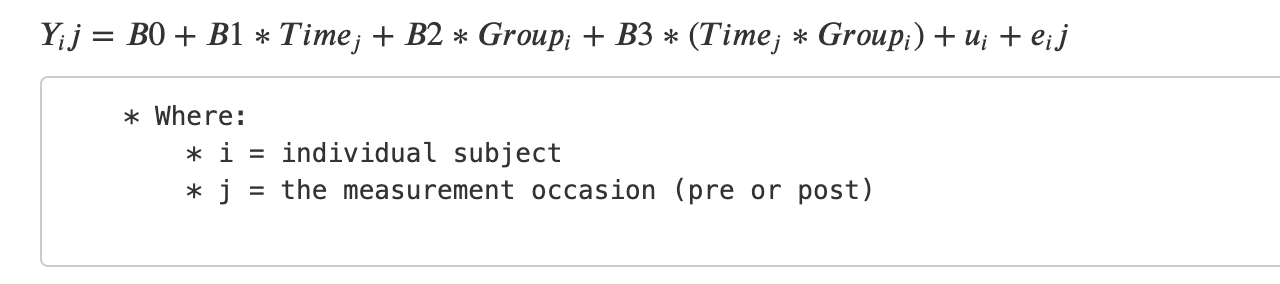
- They don’t explain anything about what covariates are in their ANCOVA, which is strange because there are no covariates in their data (I guess they could use pre-test values). This is probably an ANOVA with repeated measures and they stated it incorrectly. They could have instead used a mixed model. For example:
- The supplement itself is problematic given that it is reported to have 100mg and really only had 6mg/capsule? This changes the dosage of the study.